


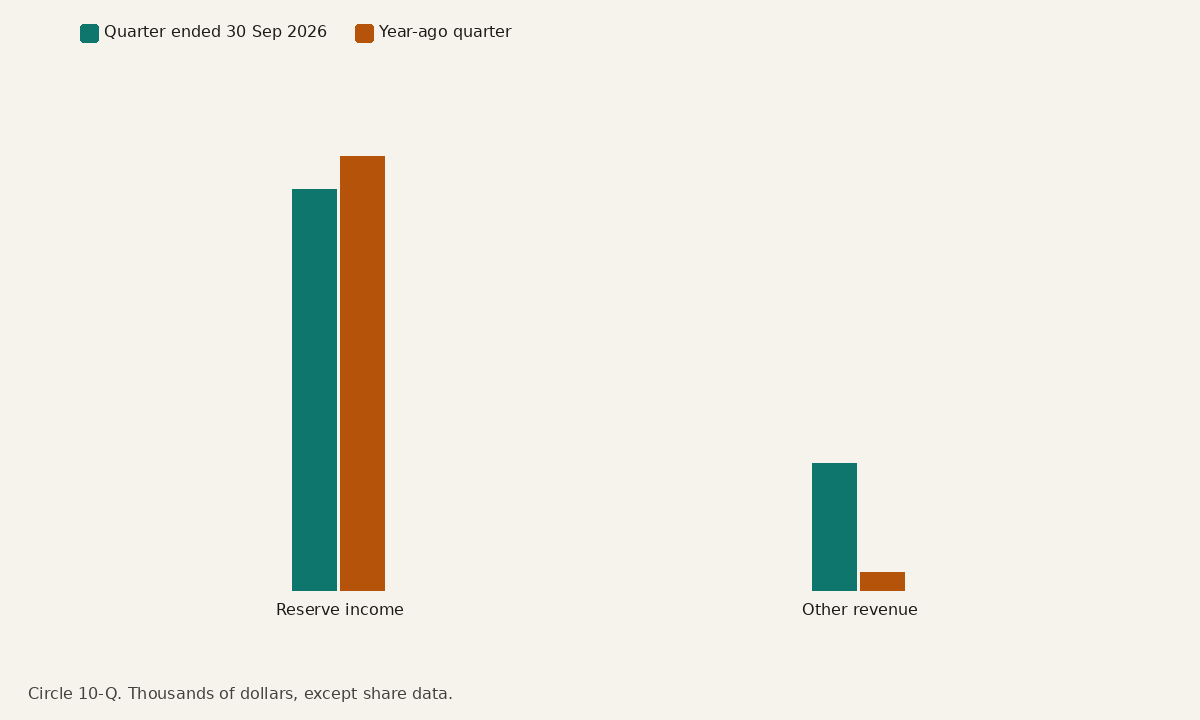
Circle Internet Group’s quarterly report, filed on 4 November 2026, puts reserve income and other revenue on different lines. For the three months ended 30 September 2026, reserve income is $657,624 thousand and other revenue is $207,264 thousand. Total revenue and reserve income is $864,888 thousand. The same morning’s earnings 8-K does not repeat those lines. It says a press release is attached as Exhibit 99.1 and that Item 2.02 is not deemed filed under Exchange Act Section 18.
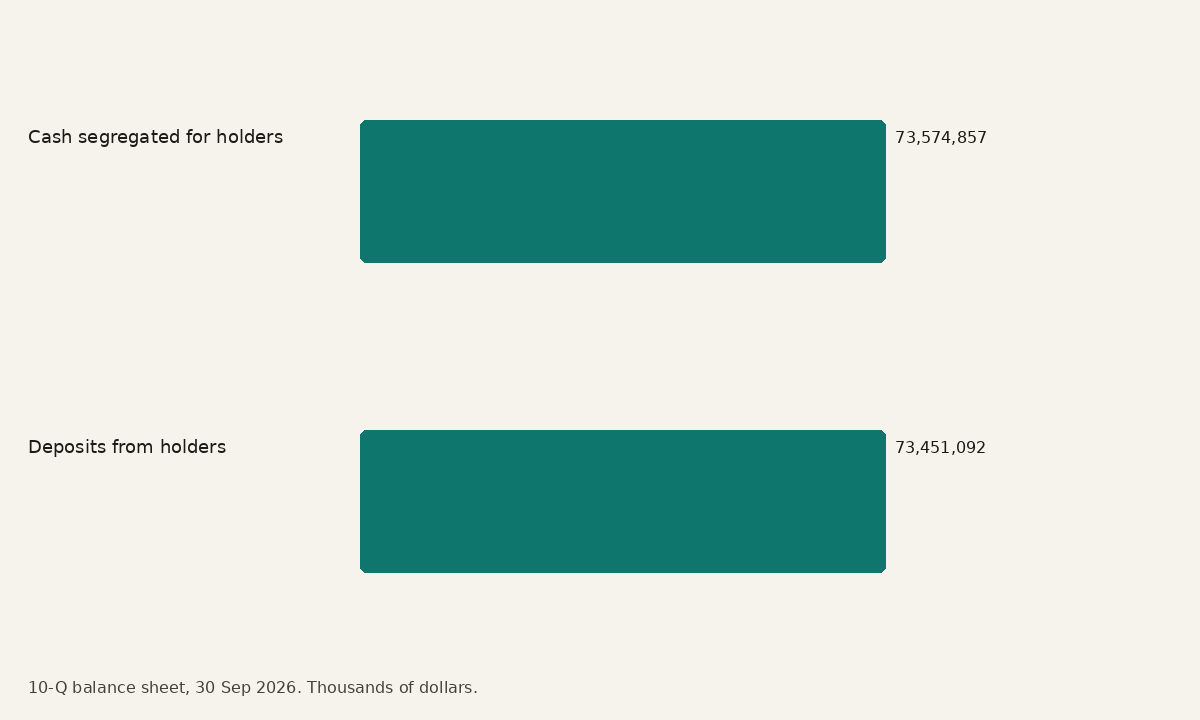
The balance sheet is the other split. Cash and cash equivalents segregated for the benefit of stablecoin holders are $73,574,857 thousand at 30 September 2026. Deposits from stablecoin holders, a liability, are $73,451,092 thousand. A sentence that calls the whole amount Circle’s cash is reading past the segregation note.
Who this is for
This is for a reader who sees a Circle or USDC headline and needs the filed page, not a recap of the press release. The method for a reserve attestation in general is already in how to read a stablecoin reserve attestation. This page is the Circle document map: which report holds the reserve lines, and which report only furnishes the earnings release.
Prerequisites
- The EDGAR record for CIK 0001876042, Circle Internet Group, Inc. The company filings page is the index. The two documents below are the ones this guide uses.
- A distinction you can check in the form itself: Item 2.02 of an 8-K is often furnished. A 10-Q is the quarterly report.
- The short USDC definition on our USDC glossary page, so the ticker and the reserve are not treated as the same object.
Steps
- Start with the Form 10-Q filed on 4 November 2026, not with the press release. The statements say the figures are in thousands, except share information. Every dollar figure below keeps that unit until the company’s own narrative converts it.
- Read the revenue block as two businesses sitting on one total. Reserve income for the September 2026 quarter is $657,624 thousand, against $711,241 thousand in the September 2025 quarter. Other revenue is $207,264 thousand, against $28,518 thousand. Total revenue and reserve income is $864,888 thousand, against $739,759 thousand. The nine-month reserve-income figures on that same row are $1,977,865 thousand and $1,903,426 thousand.
- Use the management discussion only where it already states the rounded figure. The 10-Q says average USDC in circulation of $73.3 billion increased 8% year over year, onchain transaction volume grew 49% to $13.9 trillion, total revenue and reserve income grew 17% to $865 million, and net income from continuing operations increased 5% to $226 million. It also points readers to a non-GAAP reconciliation for adjusted EBITDA. This guide does not restate that non-GAAP line as if it were the revenue total.
- Move to the balance sheet for the reserve itself. Segregated cash and cash equivalents held for stablecoin holders are $73,574,857 thousand at 30 September 2026 and $75,067,932 thousand at 31 December 2025. A separate line, segregated cash for corporate-held stablecoins, is $1,016,461 thousand at the quarter end. Corporate cash and cash equivalents, not in those segregated lines, are $1,699,951 thousand.
- Read the liability that sits opposite the holder cash. Deposits from stablecoin holders are $73,451,092 thousand at 30 September 2026 and $74,912,567 thousand at 31 December 2025. The gap between segregated holder cash and that deposit liability is visible on the page. It is not a second reserve the company invented in a headline.
- Read the segregation note before any sentence about ownership. The 10-Q says the company segregates assets backing Circle stablecoins, holds only bare legal title in the accounts, and maintains no legal, equitable, financial, or ownership interest over the reserves held for stablecoin holders. It also says eligible liquid assets were greater than the aggregate custodial funds due to customers for the periods presented.
- Name the reserve vehicle the note actually names. Subsidiaries hold shares in the Circle Reserve Fund, a money market fund managed by BlackRock Advisors, LLC. The note says securities the fund buys are subject to Rule 2a-7 under the Investment Company Act of 1940, and that fund shares are only available for purchase by certain Circle subsidiaries. That is a filed description of the vehicle. It is not, by itself, a monthly accountant’s attestation letter. This 10-Q does not attach a separate attestation URL, so this guide does not invent one.
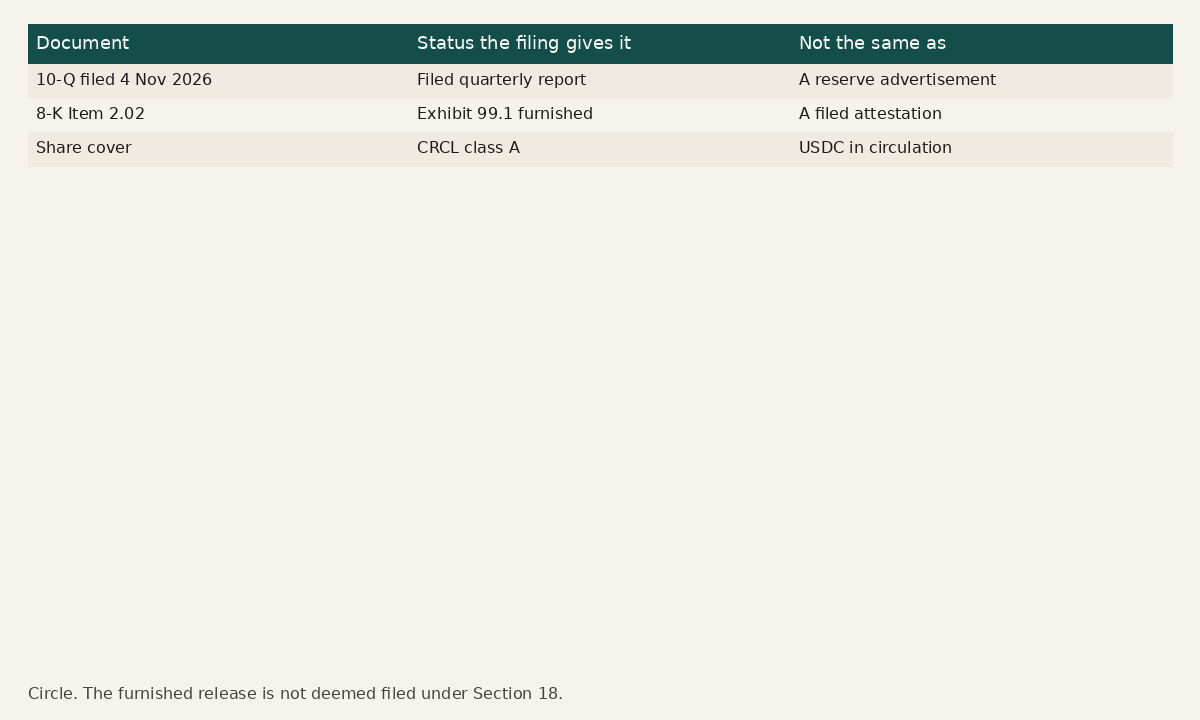
- Only then open the Form 8-K filed the same day. Item 2.02 says the company issued a press release on third-quarter results and attaches it as Exhibit 99.1. The item then says that information shall not be deemed filed for Section 18. If a figure exists only in the furnished release and not in the 10-Q, keep that label on it.
Not what the headline says
Reserve income fell versus the year-ago quarter on the face of the statement, from $711,241 thousand to $657,624 thousand, while other revenue rose sharply and the combined total rose. A headline that says Circle’s revenue grew, and a headline that says reserve income was lower, can both be pointing at this same table. They are different lines.
USDC in circulation, as the company describes the average in the narrative, is not the same number as segregated cash, and neither number is Circle’s corporate cash. The glossary definition the company prints in the 10-Q says a payment stablecoin is meant to hold a stable value against a reference currency, be redeemable one for one, and be backed by a reserve whose value meets or exceeds the redemption value. That definition is a design description inside the filing. It is not a promise that the share price of CRCL tracks the token.
A worked comparison
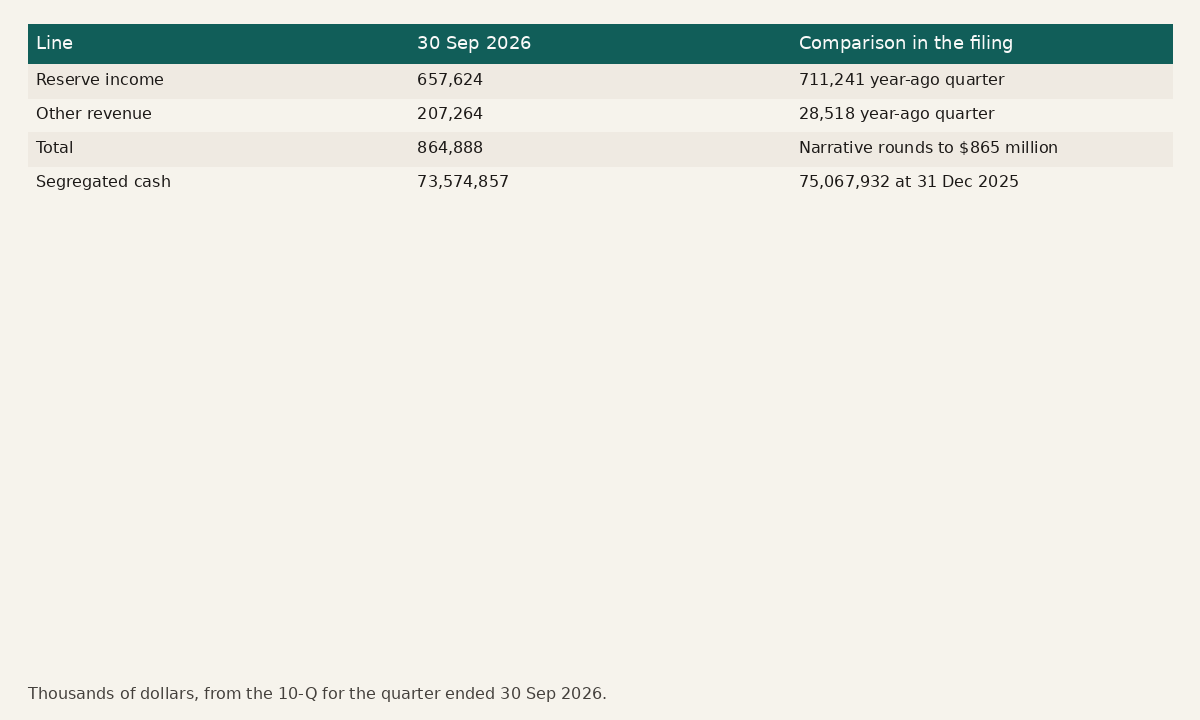
| Line | 30 Sep 2026 | Comparison the filing prints |
|---|---|---|
| Reserve income, quarter | $657,624 thousand | $711,241 thousand in the year-ago quarter |
| Other revenue, quarter | $207,264 thousand | $28,518 thousand in the year-ago quarter |
| Total revenue and reserve income | $864,888 thousand | Narrative rounds the growth to $865 million, up 17% |
| Cash segregated for holders | $73,574,857 thousand | $75,067,932 thousand at 31 Dec 2025 |
| Deposits from stablecoin holders | $73,451,092 thousand | $74,912,567 thousand at 31 Dec 2025 |
| Earnings 8-K Item 2.02 | Exhibit 99.1 attached | Not deemed filed under Section 18 |
One more cut is worth making out loud. Average USDC in circulation of $73.3 billion is the company’s narrative figure for the quarter. The $73,574,857 thousand segregated-cash line is a balance-sheet stock at 30 September. An average over a quarter and a balance on the last day will not match, and the filing does not ask them to. Onchain transaction volume of $13.9 trillion is a flow the narrative reports. It is not assets on the balance sheet.
The nine-month columns are a third reading, not a restatement of the quarter. Reserve income for the nine months ended 30 September 2026 is $1,977,865 thousand, against $1,903,426 thousand in the prior-year nine months. Total revenue and reserve income for those nine months is $2,260,336 thousand, against $1,976,410 thousand. A quarter in which reserve income is lower than the year-ago quarter can still sit inside a nine-month total that is higher. The statement prints both. Quoting only one of them is how a later summary appears to contradict the filing.
The year-end comparison on the balance sheet is just as dated. Corporate cash and cash equivalents were $1,526,046 thousand at 31 December 2025 and $1,699,951 thousand at 30 September 2026. Cash segregated for corporate-held stablecoins was $822,963 thousand at year-end and $1,016,461 thousand at the quarter. None of those lines replaces the holder-segregated cash of $73,574,857 thousand. If a sentence needs a cash number, it also needs the line name and the date.
The $13.9 trillion onchain figure has a definition attached, and the definition is part of the number. The 10-Q’s description of USDC onchain transaction volume excludes Solana. Dropping that exclusion makes the volume look like a count of every chain the token touches. A nearby sentence about competitors that publish periodic attestations is also not a link to a Circle attestation. The sentence names a market practice. It does not hand you a PDF for this issuer.
Common mistakes
- Adding segregated holder cash to corporate cash and calling the sum Circle’s reserves. The statements already split those lines.
- Quoting adjusted EBITDA from the narrative without the filing’s own warning that it is non-GAAP and reconciled elsewhere in the report.
- Treating Exhibit 99.1 as if Item 2.02 had filed it. The 8-K says the opposite.
- Looking for a standalone attestation PDF inside this 10-Q and, on not finding a link, substituting a blog recap. The filed reserve description is the note summarized above. Our attestation guide covers how to read a report when the issuer does publish one.
Related reading
The general reserve-report habit is in how to read a stablecoin reserve attestation. USDC is the glossary entry, and custody is the nearby term for assets held for someone else. The crypto guide library is the shelf for both.