

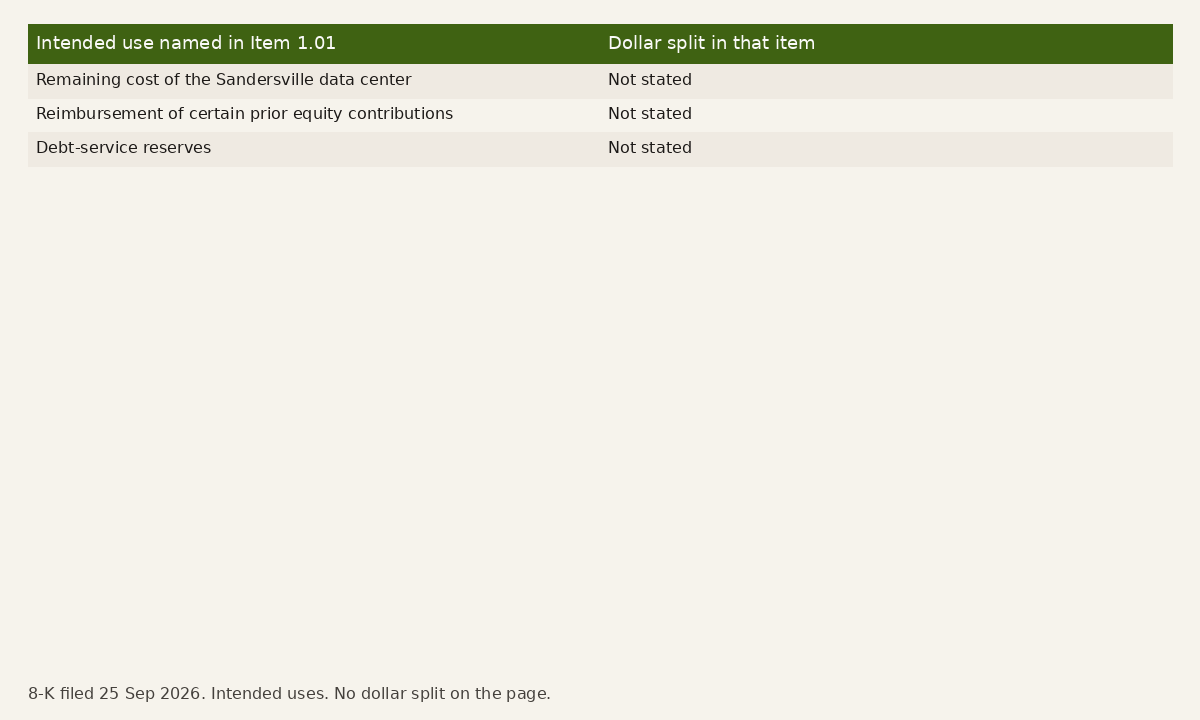
CleanSpark’s 8-K filed on 25 September 2026 reports a completed private offering of 7.875% senior secured notes due 2031, with an aggregate principal amount of $2,276.0 million, issued at 98.500% of principal. The issuer is CSDC Finance I, LLC, a wholly owned indirect subsidiary. The same item lists three intended uses of the net proceeds: the remaining cost of the Sandersville data center, reimbursement of certain prior equity contributions for that facility, and debt-service reserves. It does not split the $2,276.0 million across those three uses, so a chart that assigns dollar shares to them would be inventing a table the filing does not have.
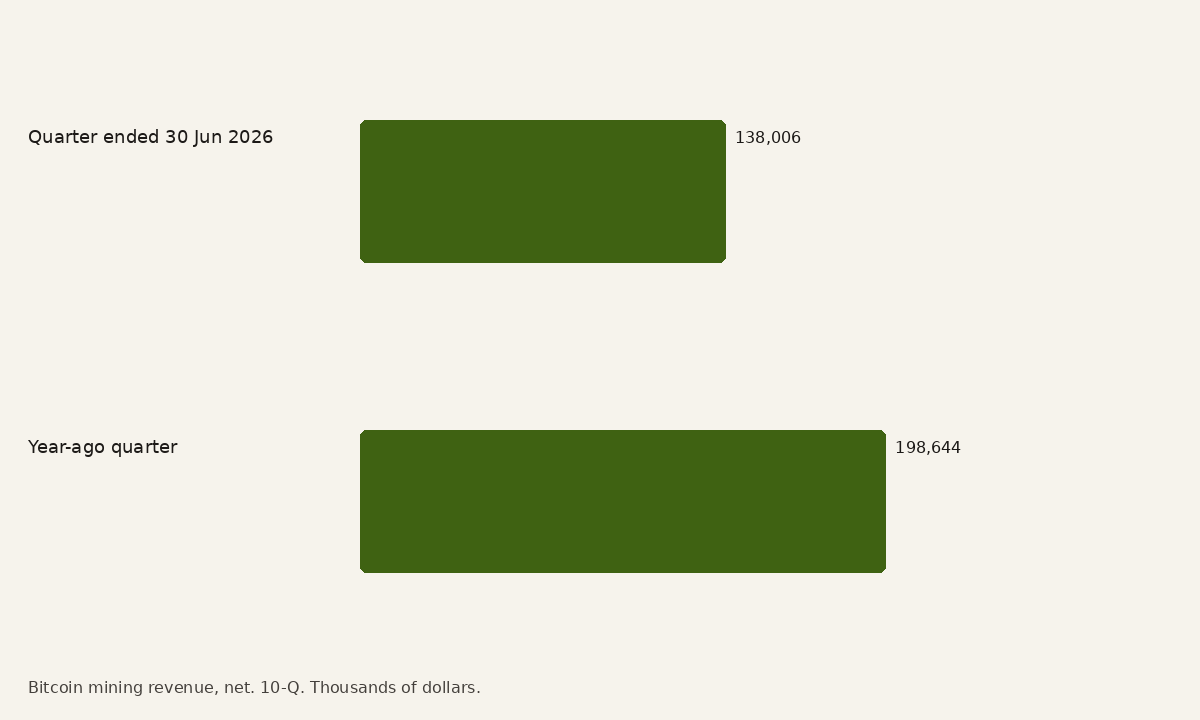
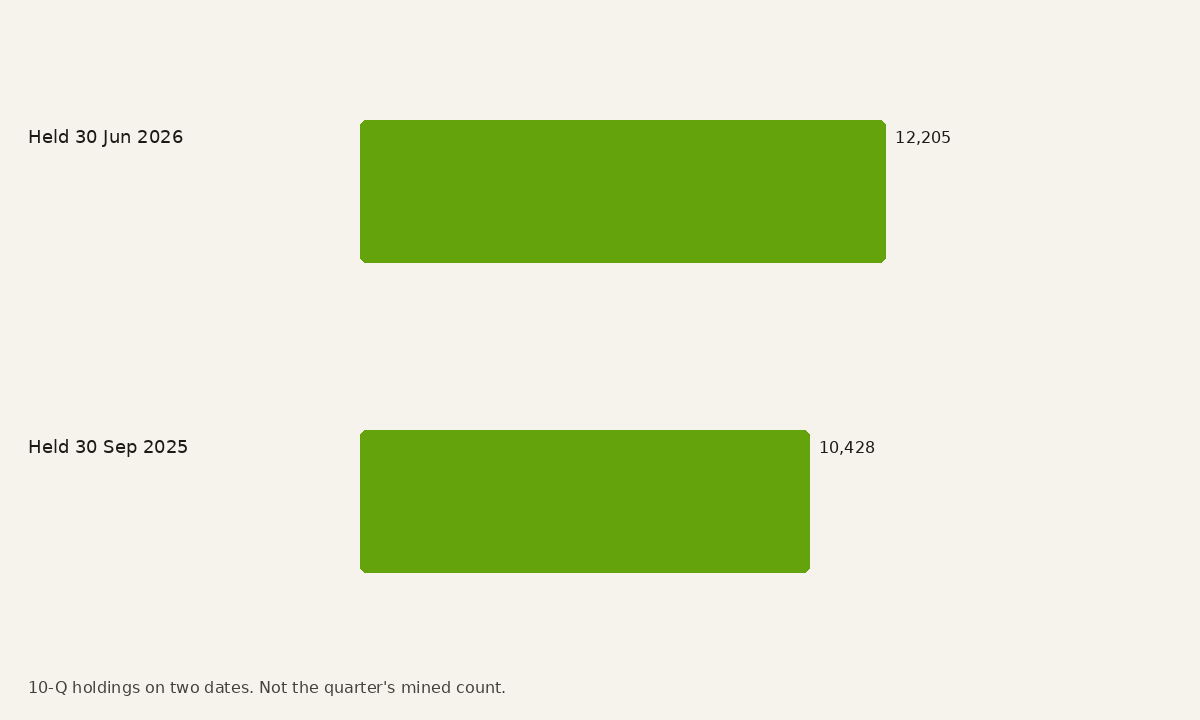
Mining results sit in a different report, for a different date. The Form 10-Q for the quarter ended 30 June 2026 says bitcoin mining revenue, net, was $138,006 thousand for that quarter, against $198,644 thousand in the year-ago quarter. It also says the company held 12,205 bitcoin at 30 June 2026 and 10,428 bitcoin at 30 September 2025. A furnished press release the same week as that 10-Q repeats a revenue headline and adds a lease headline. The 8-K that attaches the release says Item 2.02 is not deemed filed.
Who this is for
This is for a reader who sees a CleanSpark headline about notes, a lease, or bitcoin production and wants the document that actually contains the sentence. The general habit of reading an item number is in how to read a crypto 8-K. Dated news posts about the September notes stay news. This page is the map of which filing holds which kind of sentence.
Prerequisites
- CIK 0000827876. The cover of the June quarterly report lists CleanSpark, Inc. as a Nevada corporation, file number 001-39187.
- Three document types: an Item 1.01 8-K for a material agreement, a Form 10-Q for the quarter, and an Item 2.02 8-K that furnishes an earnings exhibit.
- A willingness to leave a dollar figure undivided when the filing names categories without amounts.
Steps
- Open the 25 September 2026 Form 8-K and stay on Item 1.01. The purchase agreement is dated 18 September 2026, among CleanSpark, CSRE Properties Sandersville, LLC as subsidiary guarantor, and Morgan Stanley & Co. LLC as representative of the initial purchasers. The notes were sold to qualified institutional buyers under Rule 144A and to non-U.S. persons under Regulation S.
- Copy the price and the uses without filling gaps. Aggregate principal $2,276.0 million. Issue price 98.500% of principal. Intended use of net proceeds: finance the remaining cost of the Sandersville Facility, a data center in Sandersville, Georgia; reimburse the company for certain prior equity contributions for that facility; fund debt service reserves. The 8-K itself labels the intended-use sentence as a forward-looking statement. It is a plan stated on the filing date, not a later audit of where the cash went.
- Note the features the item does specify, and stop where the indenture is only referenced. Principal amortizes semi-annually on 1 April and 1 October after a Final Commencement Date, toward a target coverage ratio. Both of those terms are defined in the indenture, which this 8-K does not reprint as numbers. Optional redemption before 1 October 2028 is at 100% plus a make-whole and accrued interest. Up to 40% of principal may be redeemed before that date with certain equity-offering proceeds, at the indenture price plus accrued interest. A change-of-control offer is at 101% plus accrued interest. The exhibit list names the indenture dated 25 September 2026, with U.S. Bank Trust Company, N.A. as trustee and collateral agent.
- For operating results, leave September and open the Form 10-Q for the quarter ended 30 June 2026. Bitcoin mining revenue, net, is $138,006 thousand for the three months and $455,594 thousand for the nine months, against $198,644 thousand and $542,662 thousand in the prior-year periods. Those figures are in thousands, as the statement header says.
- Read the bitcoin count from the note, not from a market-value headline. As of 30 June 2026 and 30 September 2025 the company held 12,205 and 10,428 bitcoin. The note also splits the 30 June carrying amounts into bitcoin current of $592,058 thousand and bitcoin noncurrent of $122,235 thousand. A press-release HODL figure that adds collateral arrangements is a different composition. Do not add the two balance-sheet lines and rename the sum.
- Keep hashrate next to the sentence that defines it. The 10-Q says that during June 2026 the company’s operating mining units produced an average computing power of 42.6 EH/s, after a peak hashrate of 50 EH/s during fiscal year 2025. It defines hashrate as the computing power that processes bitcoin-network transactions and calls it a significant driver of mining revenue. Hashrate is not the revenue line.
- If you need a cost the statements actually compute per coin, the 10-Q says cost of energy per bitcoin mined at owned facilities was $44,317 for the June 2026 quarter, against $44,690 in the year-ago quarter, and that these per-bitcoin amounts are actual rather than in thousands. Miner depreciation per bitcoin mined is $51,871 for that quarter. Contracted power capacity is approximately 1,817 MW as of 30 June 2026.
- Open the furnished exhibit only after the filed pages. The 6 August 2026 Exhibit 99.1 says the company signed a 20-year $6.6 billion triple-net lease at Sandersville, and it prints quarterly revenues of $138.0 million. The 8-K that attaches it says the press release is furnished, not filed, under Item 2.02. The lease dollar and the HODL dollar in that release are exhibit sentences. Mining revenue you can cite as a financial-statement line is the $138,006 thousand in the 10-Q.
Not what the headline says
A notes headline, a lease headline, and a bitcoin-held headline can appear in the same week of coverage and still come from three documents. The notes item is an agreement that closed. The lease sentence is in a furnished earnings exhibit. The 12,205 bitcoin figure is a 30 June holding, not a count of coins mined in a named month. The 10-Q extract used here does not print a separate ‘coins mined this month’ total, so this guide does not supply one.
The September 8-K also says the notes limit additional debt, dividends, investments, liens, asset sales, and other actions, and that CleanSpark gave a completion guarantee to fund the issuer if note proceeds and available funds are not enough to finish Sandersville. Those are covenants and a guarantee described at a high level. They are not a statement that the data center was finished on the filing date.
A worked comparison
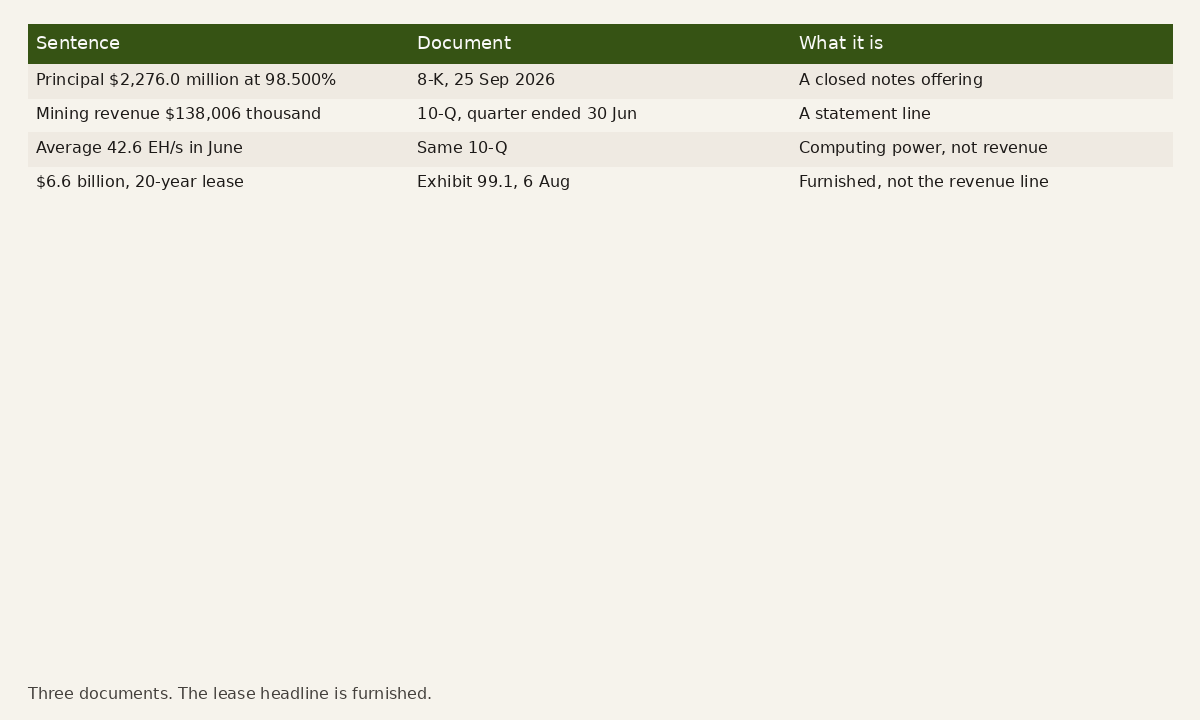
| Sentence | Document | What it is |
|---|---|---|
| Principal $2,276.0 million at 98.500% | 8-K Item 1.01, 25 Sep 2026 | A closed private offering of notes |
| Three named uses of net proceeds | Same item | Intended uses, with no dollar split |
| Mining revenue $138,006 thousand | 10-Q, quarter ended 30 Jun 2026 | A statement line, in thousands |
| 12,205 bitcoin | Same 10-Q, as of 30 Jun 2026 | Holdings, not a monthly production count |
| Average 42.6 EH/s in June 2026 | Same 10-Q | Operating computing power, defined in the note |
| $6.6 billion, 20-year lease | Exhibit 99.1, 6 Aug 2026 | Furnished with the earnings release |
The revenue comparison is the cleanest filed pair. $138,006 thousand against $198,644 thousand is the statement’s own year-over-year line for the June quarter. The exhibit rounds the current-year figure to $138.0 million and describes a decline of $60.6 million, or 30.5%, from $198.6 million. Use the statement when you need the unrounded thousands. Use the exhibit when you are quoting the company’s furnished wording, and say that you are.
Two cost lines from the same 10-Q keep the production story from collapsing into a single hashrate. Direct energy plus other direct non-energy utilities is $44,406 per bitcoin mined for the June 2026 quarter. The nine-month cost of energy per bitcoin mined at owned facilities is $47,339, against $40,616 in the prior-year nine months. A higher hashrate sentence and a lower revenue sentence can both be in the quarter. The filing prints 42.6 EH/s and $138,006 thousand side by side. It does not say one caused the other in a single formula you can reuse next month.
The August exhibit also prints a HODL value of $814.9 million as of 30 June 2026, and it says that figure consists of current bitcoin, non-current bitcoin, and bitcoin held by counterparties related to collateral arrangements. That composition is why it will not equal $592,058 thousand plus $122,235 thousand. Cash in the same release is $202.6 million. Quarterly revenue in the release is $138.0 million. Each of those is a furnished figure with its own definition. The filed revenue line remains $138,006 thousand.
Common mistakes
- Dividing $2,276.0 million into three equal uses because the 8-K names three purposes. It does not assign amounts.
- Saying the proceeds were spent on Sandersville. The item says the issuer intends to use the net proceeds that way, and it flags the sentence as forward-looking.
- Putting the September notes into the 30 June debt total. The quarterly report predates the closing.
- Treating 42.6 EH/s, or the furnished $814.9 million HODL value in the August release, as GAAP revenue. The revenue line is $138,006 thousand.
Related reading
Item numbers in general are covered in how to read a crypto 8-K. Bitcoin history is the coin, separate from this issuer’s production sentences. Market structure is the glossary entry for how a market is organized, and the crypto guide library holds the method pages.