


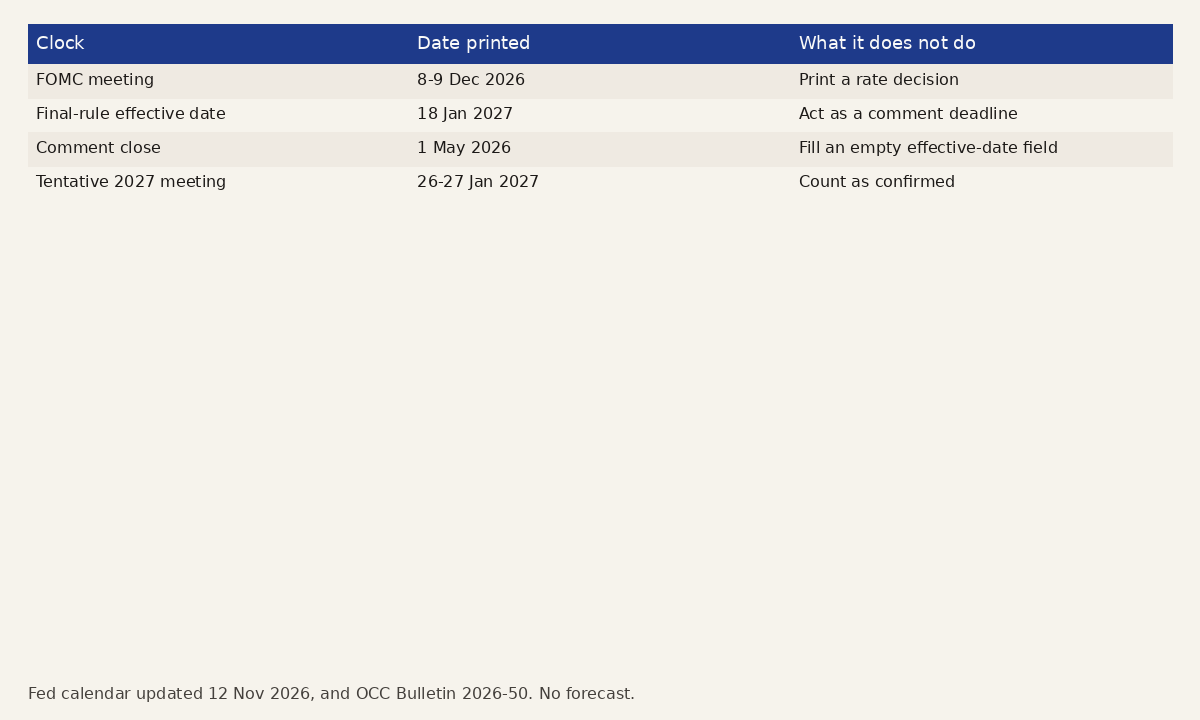
A policy date is not one kind of date. On the Federal Reserve’s FOMC calendar, updated 12 November 2026, 8 and 9 December 2026 is a meeting. On the OCC’s Bulletin 2026-50, 18 January 2027 is the effective date of a final rule. On the proposed-rule PDF published 2 March 2026, 1 May 2026 is a comment deadline that has already closed, and the document’s effective-date field is empty. Those three clocks do different jobs. A calendar that sorts them into one ‘crypto news’ column will treat a meeting, a rule that is not yet in force, and a comment window that is over as if they were the same event.
This page lists dates that are printed on those sources. It does not add a column for what the FOMC will decide, and it does not turn a comment deadline into an effective date.
Who this is for
This is for a reader who sees a crypto policy headline with a date in it and needs to know what that date changes. A complaint, a settlement, and an allegation are a different reading job. That job is how to read a CFTC or SEC filing as a trader. This page is the clock, not the docket.
Prerequisites
- The FOMC calendars page. The copy used here says it was last updated on 12 November 2026. A later update can move a tentative date. It does not change what a meeting date means.
- OCC Bulletin 2026-50, the agency’s own page for the GENIUS Act final rule, plus the March proposal PDF on GovInfo so the comment deadline has a document.
- A label you can apply before you share the date: meeting, effective date, or comment close.
Steps
- Start with the kind of document, not the topic word. ‘Stablecoin’, ‘custody’, and ‘bitcoin’ can each appear on a meeting agenda, a proposal, and a final rule. The topic does not tell you whether anything changed on that date.
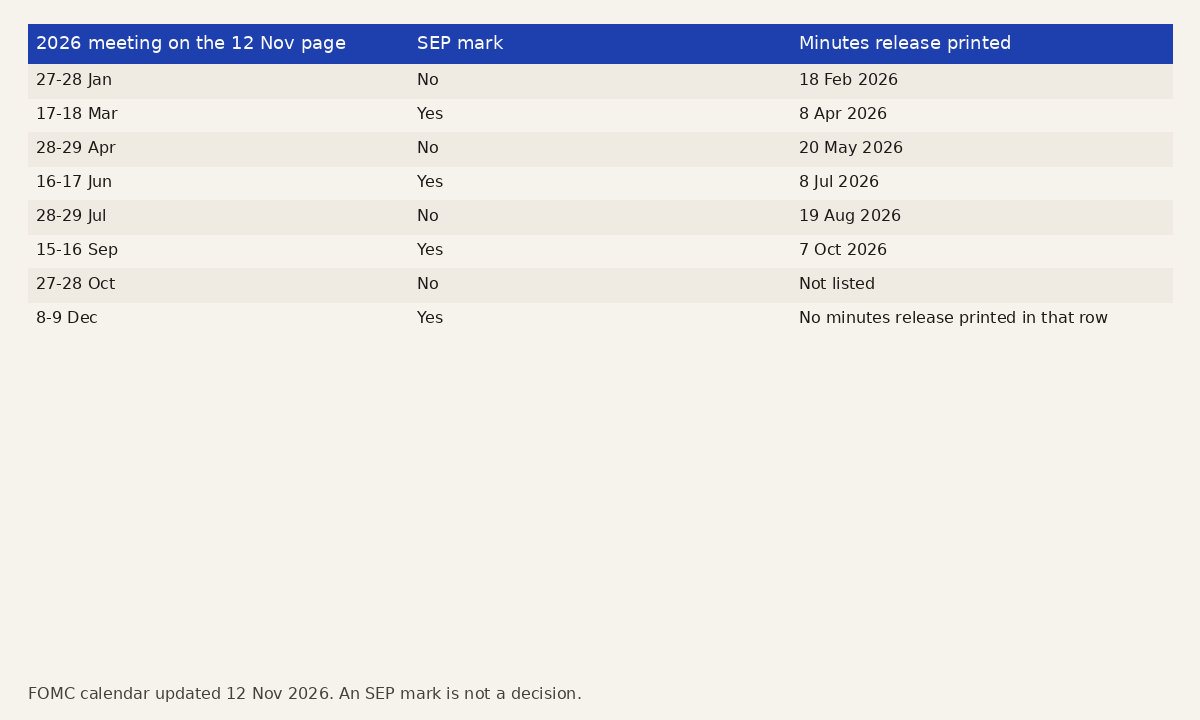
- For a monetary-policy meeting, read the Board’s calendar as a list of dates and a minutes-release note. The 2026 rows, as printed on the page updated 12 November 2026, are 27 to 28 January, with minutes released 18 February 2026; 17 to 18 March, with minutes released 8 April 2026; 28 to 29 April, with minutes released 20 May 2026; 16 to 17 June, with minutes released 8 July 2026; 28 to 29 July, with minutes released 19 August 2026; 15 to 16 September, with minutes released 7 October 2026; 27 to 28 October, with the statement posted and minutes not listed as released on that page; and 8 to 9 December. An asterisk on the March, June, September, and December rows means the calendar associates that meeting with a Summary of Economic Projections. The asterisk is not a decision.
- Read the 2027 rows as tentative. The same page says each meeting date is tentative until confirmed at the meeting immediately preceding it. The dates it lists are 26 to 27 January, 16 to 17 March, 27 to 28 April, 8 to 9 June, 27 to 28 July, 14 to 15 September, and 26 to 27 October. It also lists a Monetary Policy Strategy Meeting on 16 to 17 November 2027, and a two-day meeting on 25 to 26 January 2028. Copy the word tentative with the date.
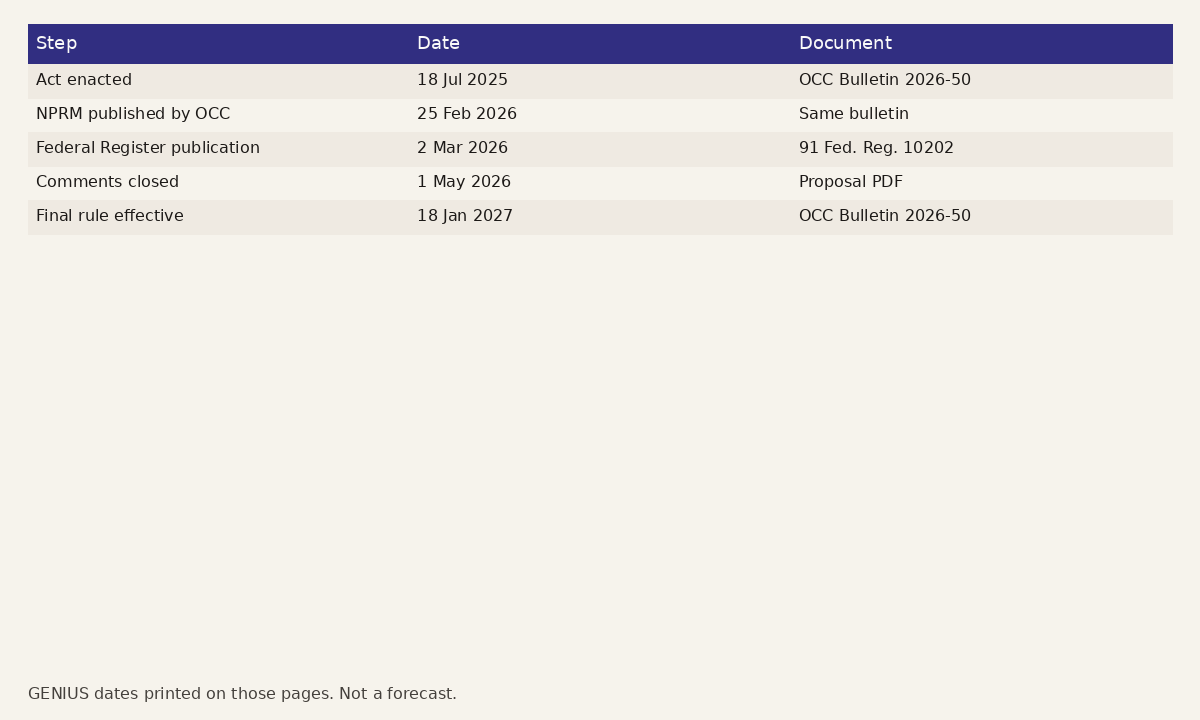
- For a final rule, open the agency bulletin and find the effective-date sentence. OCC Bulletin 2026-50 says the OCC is issuing a final rule to implement the GENIUS Act for payment-stablecoin issuance and related activities by entities under OCC jurisdiction, and that the final rule is effective 18 January 2027. The bulletin also says the Act was enacted on 18 July 2025 and that the Act’s effective date is 18 January 2027. Our note on that bulletin keeps the same distinction: a 2027 clock, not a license that is already in hand.
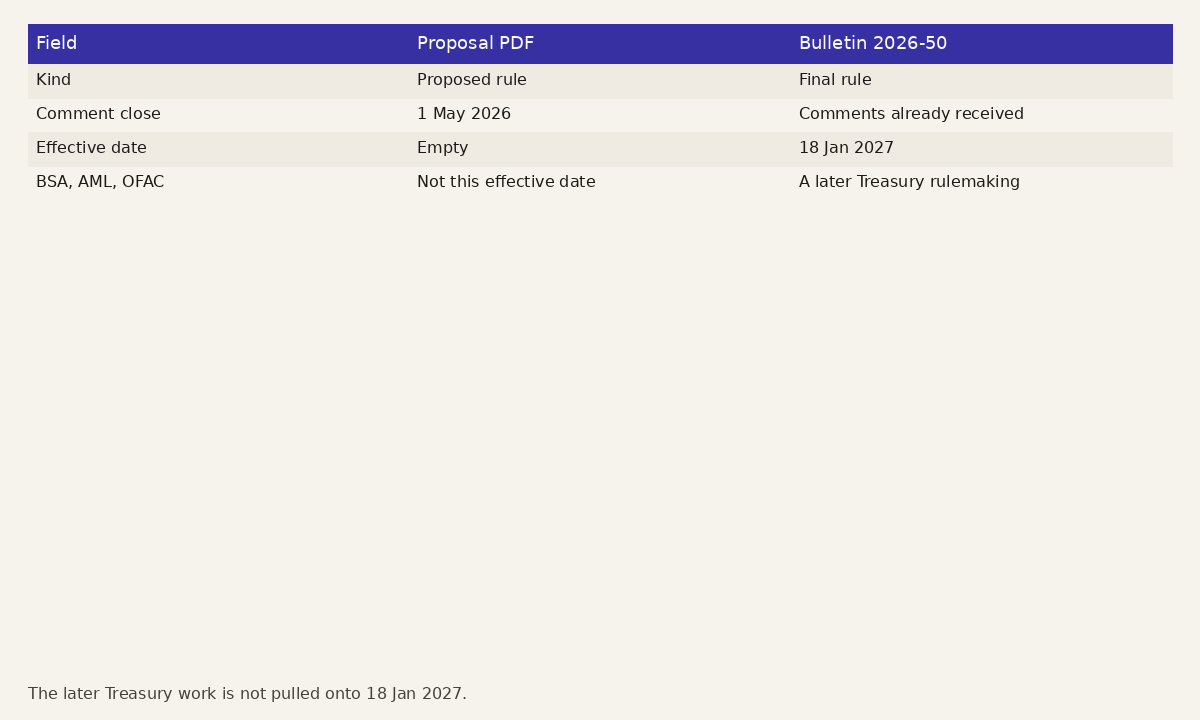
- Read who the bulletin says the rule applies to, and stop there. It names national banks and their subsidiaries, federal savings associations and their subsidiaries, federal branches and their subsidiaries, foreign payment-stablecoin issuers, nonbank entities seeking to be or approved as federal qualified payment-stablecoin issuers, and state qualified issuers over whom the OCC has regulatory or enforcement authority under the Act. Most of the rules go in a new 12 CFR part 15. The bulletin also says it revises 12 CFR parts 3, 6, 8, and 19, and that BSA, AML, and OFAC requirements are a separate later rulemaking with Treasury. Do not fold that later rulemaking into the 18 January date.
- For a comment deadline, open the proposal and look for a close date that is actually filled in. The GovInfo PDF of the 2 March 2026 proposed rule is the OCC proposal on GENIUS Act stablecoin issuance. Its publication date is 2 March 2026. Its comments-close date is 1 May 2026. Its effective-date field is null. A closed comment window is not the final rule. The final rule’s effective date is the one in Bulletin 2026-50.
- If a release says only that comments are due a number of days after publication in the Federal Register, and it does not print the publication date, leave the calendar cell blank. Do not count sixty days from the press-release date and publish the result as a deadline. The proposal PDF above is usable because the close date is in the document. A press release that withholds the publication date is not.
Not what the headline says
8 and 9 December 2026 being on the FOMC calendar does not tell you the rate decision, the statement language, or whether any crypto firm is mentioned. It tells you the Board has scheduled a meeting, that the page associates it with a Summary of Economic Projections, and that minutes are a later document. Until those minutes are listed, the calendar is not a substitute for them.
18 January 2027 being the effective date does not mean every stablecoin activity is legal or illegal on the day before. It means the bulletin sets that date for the final rule it describes, for the entities it lists. The prohibited-issuer sentences in the bulletin cite the Act’s own sections. They are part of the bulletin’s explanation of the statute, and they take their timing from the effective-date sentence rather than from the day the bulletin was posted.
1 May 2026 being a comment close means the proposal’s comment period ended. People who wanted a sentence in the record needed it by then. The empty effective-date field on that same document means you still look to the final rule for the day the regulation starts.
A worked comparison
| Clock | Date printed | What changes | What does not |
|---|---|---|---|
| FOMC meeting | 8–9 Dec 2026, on the calendar updated 12 Nov 2026 | A meeting is on the schedule, with an SEP mark | No decision is printed on the calendar row |
| Final-rule effective date | 18 Jan 2027, OCC Bulletin 2026-50 | The bulletin’s final rule takes that effective date | The date is not a comment deadline |
| Comment close | 1 May 2026, on the 2 Mar 2026 proposal | The proposal’s comment period ended | The proposal’s effective-date field is empty |
| Tentative 2027 meeting | 26–27 Jan 2027, labeled tentative | A date the Board has listed | It is not confirmed until the preceding meeting |
The 2026 minutes column is a useful check on the same habit. Where the calendar prints a release date, that date is when the minutes became a public document, not when the meeting’s decision took effect. February 18, April 8, May 20, July 8, August 19, and October 7 are release dates for the meetings that precede them. The October 2026 meeting row, on the 12 November update, does not list a minutes release. Leaving that cell blank is the accurate reading.
The GENIUS dates are a chain, and the chain is why a single day will not do. The bulletin says the Act was enacted on 18 July 2025, the OCC published the notice of proposed rulemaking on 25 February 2026, and that notice appeared in the Federal Register on 2 March 2026, cited as 91 Fed. Reg. 10202 and OCC Bulletin 2026-3. The GovInfo record of that March document is where the 1 May 2026 comment close is printed. Bulletin 2026-50 then says the final rule incorporates or addresses the comments the OCC received, and sets the effective date at 18 January 2027. Enactment, proposal publication, comment close, and effective date are four rows. Collapsing them into ‘GENIUS happened’ drops the only information the calendar is for.
Common mistakes
- Putting an FOMC date, a comment close, and an effective date in one column labeled ‘catalyst’.
- Counting a 60-day comment period from the day a press release hit the wire when the release itself says the clock starts at Federal Register publication.
- Treating a tentative 2027 meeting date as confirmed. The calendar says it is not, until the preceding meeting confirms it.
- Reading Bulletin 2026-50’s separate BSA, AML, and OFAC rulemaking as if it shared the 18 January 2027 effective date. The bulletin says that work comes later, with Treasury.
Related reading
Allegations and dockets are covered in how to read a CFTC or SEC filing as a trader. The GENIUS bulletin, read as a 2027 effective date rather than a present license, is in that OCC note. Market structure is the glossary entry for how a market is organized, and the crypto guide library is where these method pages sit.