
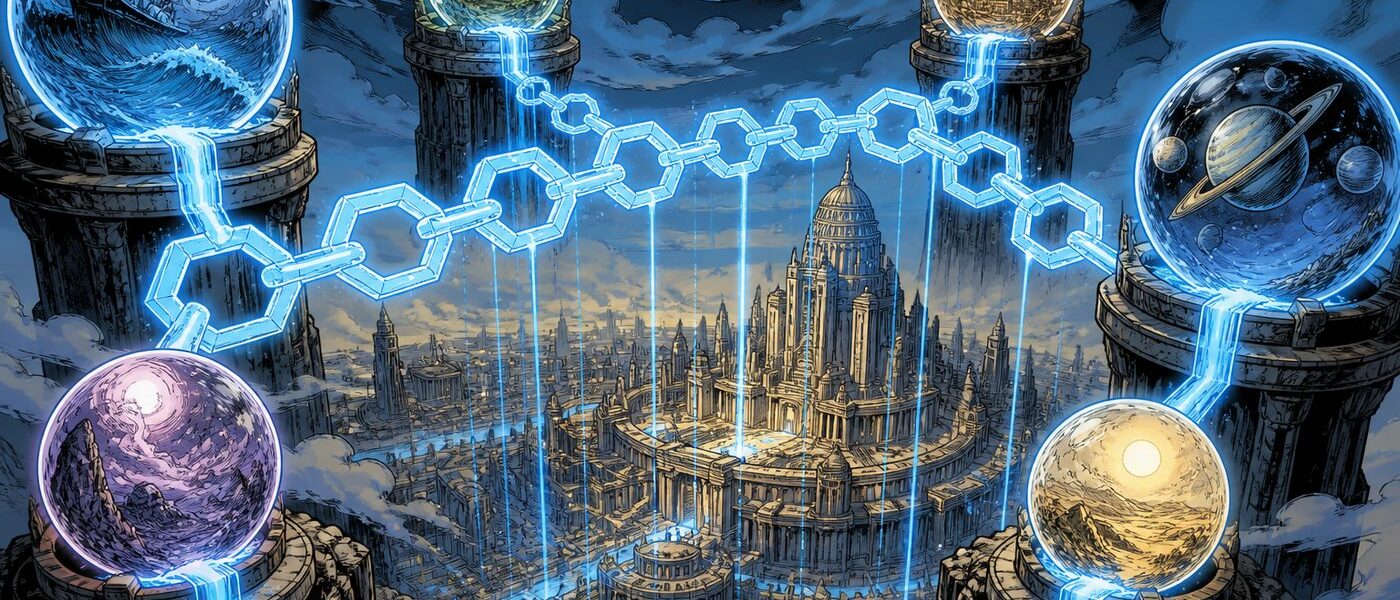
Chainlink is the leading oracle network: the pipes that bring off-chain data on-chain for DeFi and beyond. When a lending market needs a price, or a derivatives contract needs a settlement print, oracle design becomes part of the risk stack.
This page is a plain-English history with a three-year ups-and-downs lens (roughly 2023–2026). It is desk context, not a price target. Day-to-day coverage lives in Blockchain News. Keep DeFi, smart contract, and liquidity nearby.
Origin in one minute
Chainlink (LINK) began as an oracle project associated with Sergey Nazarov and the SmartContract.com team. The public white paper era and 2017 token sale placed LINK among the early infrastructure tokens that survived into later cycles. The core problem was simple to state and hard to solve safely: blockchains cannot natively fetch reliable real-world data, yet DeFi needs prices, rates, weather prints, sports results, and other external facts.
Decentralized oracle networks aggregate data from multiple sources and node operators, then deliver it on-chain. That design aims to reduce single-point failure compared with one centralized API feed. It does not remove all risk. Oracle design, update frequency, circuit breakers, and economic incentives still matter when markets gap. Review oracle if your glossary set includes it, and always treat price-feed quality as part of protocol risk.
LINK became the default brand for many Ethereum DeFi price feeds through the 2020–2021 boom. Integrations across lending, synthetics, and insurance-style products created a network-effect story: more protocols using Chainlink made Chainlink harder to displace for those use cases. That moat is real in mindshare. It is not a permanent monopoly claim on every chain or every data type.
By 2023–2026 the product story had widened beyond price feeds into cross-chain messaging and interoperability via CCIP (Cross-Chain Interoperability Protocol), plus broader “secure off-chain computation and data” packaging. Traders still mostly price LINK as infrastructure beta tied to DeFi activity, with intermittent narrative spikes when CCIP or institutional oracle headlines hit. Compare with Ethereum history and Uniswap history, because DeFi volume and oracle demand often rhyme.
Recorded ups and downs (last ~3 years)
Prices depend on venue and timestamp. The table shows the shape of each phase, not investment advice. Read prints with how to read a market snapshot.
| Period | What happened | Ups & downs (approx.) |
|---|---|---|
| 2023 | Oracle demand tracks DeFi quiet rebuild | Steady relative strength vs weaker alts |
| 2024 | CCIP and cross-chain messaging narratives expand the story | Renewed interest windows |
| 2025–2026 | Oracle + interoperability fees are the real scoreboard | Core infrastructure beta |
2023: quiet DeFi rebuild, relative resilience
2023’s DeFi tape was quieter than the prior boom, but it was not dead. Lending markets, perpetual DEXs, and stablecoin rails rebuilt after the 2022 contagion. Oracle demand tracked that rebuild. Protocols still needed reliable feeds. LINK often showed steadier relative strength versus weaker mid-cap alts that lacked a clear infrastructure role.
That relative strength was not a guarantee of absolute upside. It meant the market still treated Chainlink as core plumbing while speculative capital chased memes and newer L1 narratives. Infrastructure tokens can look “boring” in social feeds and still remain liquid majors on the book. Boring can be the point for risk managers who remember oracle failures from earlier cycles.
Staking and node-operator economics remained part of the long-term token story. Markets debate how much LINK demand comes from collateralization, staking, and fee flows versus pure speculative float. Honest desks keep those channels separate. A staking yield screenshot is not the same evidence as rising request volume paid in fees. See staking and TVL.
Regulatory and macro risk still dominated crypto beta in 2023. LINK traded inside that umbrella. When Bitcoin repaired and risk appetite returned, infrastructure names often participated. When risk-off hit, even “necessary pipes” sold. Necessity helps relative survival more than it creates a one-way bid.
2024: CCIP expands the narrative
2024 brought renewed interest windows as CCIP and cross-chain messaging narratives widened Chainlink’s story beyond “price feed company.” Bridges and messaging layers had become a standing industry headache after multiple high-profile bridge exploits in prior years. A branded interoperability protocol with oracle-security heritage was an easier story for some desks to underwrite than anonymous bridge startups.
Partnership announcements and pilot headlines around institutional data and cross-chain settlement appeared periodically. Treat pilots as pilots. A bank experiment or a standards body conversation can move the ticker for a day without proving durable fee revenue. Tag catalysts by whether they change production integrations or only conference optics.
DeFi activity on Ethereum and L2s still mattered for the classic oracle franchise. When on-chain volumes rose, feed demand and mindshare rose with them. When volumes slept, CCIP talk had to carry more of the narrative load. Keep layer 2 and Polygon history in view for scaling-context comparisons, even though Chainlink is not an L2.
LINK’s liquid major status helped during selective rallies. Size could usually find a book. That liquidity also meant LINK participated in broad alt drawdowns without needing a protocol-specific scandal. High beta to crypto risk appetite remains part of the trade even for “infrastructure.”
2025–2026: fees and integrations over slogans
By 2025–2026 the table’s scoreboard is oracle plus interoperability fees and real integrations. Mindshare is helpful. Paid usage is better evidence. Desks that only track Twitter mentions will confuse a marketing cycle with a demand cycle.
Competition exists. Other oracle designs, first-party feeds, and chain-native data solutions keep pressure on pricing and differentiation. Chainlink’s advantage is breadth of integrations and brand trust among many DeFi teams. Advantages erode if fee models or latency needs shift, or if major protocols vertically integrate data. Watch customer concentration the way you would watch any B2B franchise.
“Core infrastructure beta” in the table means LINK still sits in the liquid infrastructure bucket: correlated with crypto risk, somewhat defended by utility narrative, still vulnerable to rotations into pure meme beta or pure L1 beta. It is not a cash-flow equity. It is a token with usage hooks.
Versus pure L1s, LINK is a services-and-security story. Versus DEX governance tokens, LINK is less about trading fee switches and more about data and messaging rails. Versus bridge tokens with thin histories, LINK usually wins the trust comparison on paper, but trust still has to show up in incident-free operation under stress.
How to read Chainlink catalysts without rewriting history
LINK headlines cluster into new feed or chain integrations, CCIP partnership notes, staking or tokenomics debates, DeFi exploit post-mortems that mention oracles, and broad alt-beta moves. Integrations matter when they are production and paid. Exploits matter when they reveal design limits even if Chainlink was not the root cause. Tokenomics debates matter for float psychology.
A practical habit: when a DeFi protocol fails, ask whether the failure was oracle manipulation, thin liquidity, governance attack, or something else. Oracle is a frequent scapegoat and sometimes a real culprit. Precision keeps you from selling the entire oracle complex because one market had a bad design.
How it trades today
LINK remains among the names where serious size can usually find a bid or offer relative to the long tail of alts. Still check depth before you trust a headline. Venue quality, withdrawal status, and perpetual funding can all distort a “fair” print. Review market depth, slippage, and funding rate.
LINK often trades as a liquid infrastructure major with DeFi beta. When Ethereum gas and L2 activity rise, the oracle story gets easier to tell. When speculative attention leaves DeFi for memes or new L1s, LINK can lag even if integrations continue quietly. Quiet progress is common in infrastructure. Markets do not always pay for quiet.
Staking and node collateral narratives can tighten effective float narratives without changing spot demand overnight. Separate locked LINK from exchange inventory. Separate marketing APYs from sustainable fee capture. See circulating supply.
Related: crypto glossary, how to read a market snapshot, and all coin histories.
Cross-asset context helps. Bitcoin sets risk appetite. Ethereum sets much of DeFi’s settlement and fee weather. Solana and other L1s set competitive attention. Chainlink sits underneath many of those ecosystems as a vendor-like dependency. That is powerful and constraining at once. See Bitcoin history and Solana history.
If you use derivatives, respect liquidation cascades around event weeks. Infrastructure tokens are not immune to leverage flushes. See perpetual futures and liquidation.
Oracle update design is a trading-adjacent topic even if you never read a node operator dashboard. Heartbeat intervals, deviation thresholds, and circuit-breaker behavior decide how fast a feed reflects a violent spot move. Protocols that ignore those parameters can liquidate users incorrectly or fail to liquidate when they should. When those failures become news, LINK can trade as a guilt-by-category asset for a session. Category guilt is usually temporary. Design lessons are not.
Cross-chain messaging inherits bridge-class risks even when branded differently. Message authenticity, finality assumptions, and rate limits matter. CCIP’s pitch is safer interoperability with oracle-grade security practices. Markets will still demand an incident-free track record under stress. Until that track record is long, treat interoperability revenue as an option on adoption rather than a coupon you can count in advance.
LINK’s circulating float and exchange inventory remain classic mid-major variables. Large unlocks or wallet movements can become social events regardless of whether they hit the market. On-chain analysts argue about labels. Traders can stay humble and still ask whether today’s seller is patient or reflexive. Reflexive inventory plus thin books is how infrastructure names gap.
DeFi bluechips that embed Chainlink feeds create a subtle coupling. When those protocols grow, Chainlink’s relevance story strengthens. When they shrink or migrate to alternative data sources, the coupling loosens. Customer concentration is not always published cleanly. Approximate it by watching which ecosystems dominate feed request narratives and TVL.
Compared with application tokens, LINK is harder to value with a simple fee-switch story. Compared with L1 gas tokens, LINK is harder to value with a simple blockspace scarcity story. That valuation awkwardness is why narrative windows matter so much for the ticker. When the market wants infrastructure, awkwardness shrinks. When the market wants memes, awkwardness returns.
For execution, treat LINK like liquid infrastructure: deep enough for size on major venues, still capable of gap behavior when DeFi risk or tokenomics headlines hit thin hours. Check whether the catalyst is a production integration, a pilot announcement, or a broad alt squeeze. Those three prints deserve three different sizes.
If you need a one-line process: paid oracle and messaging usage first, integration breadth second, conference optics last. That order keeps CCIP excitement from rewriting a multi-year plumbing map that still depends on DeFi surviving its own leverage cycles.
Node operator diversity and geographic distribution are quieter resilience metrics. Concentrated operators can still deliver correct feeds most days and fail the day it matters. Markets rarely price that risk until an incident forces the conversation. When the conversation arrives, it will not wait for your research schedule.
Follow the news
Ongoing coverage: Blockchain News. For DeFi-adjacent tape, also skim Ethereum News and the coin hub at coin histories.
Use this page as the longer map. Use the categories for daily weather. Trust timestamped integration and fee evidence over the loudest interoperability slogan of the week.