
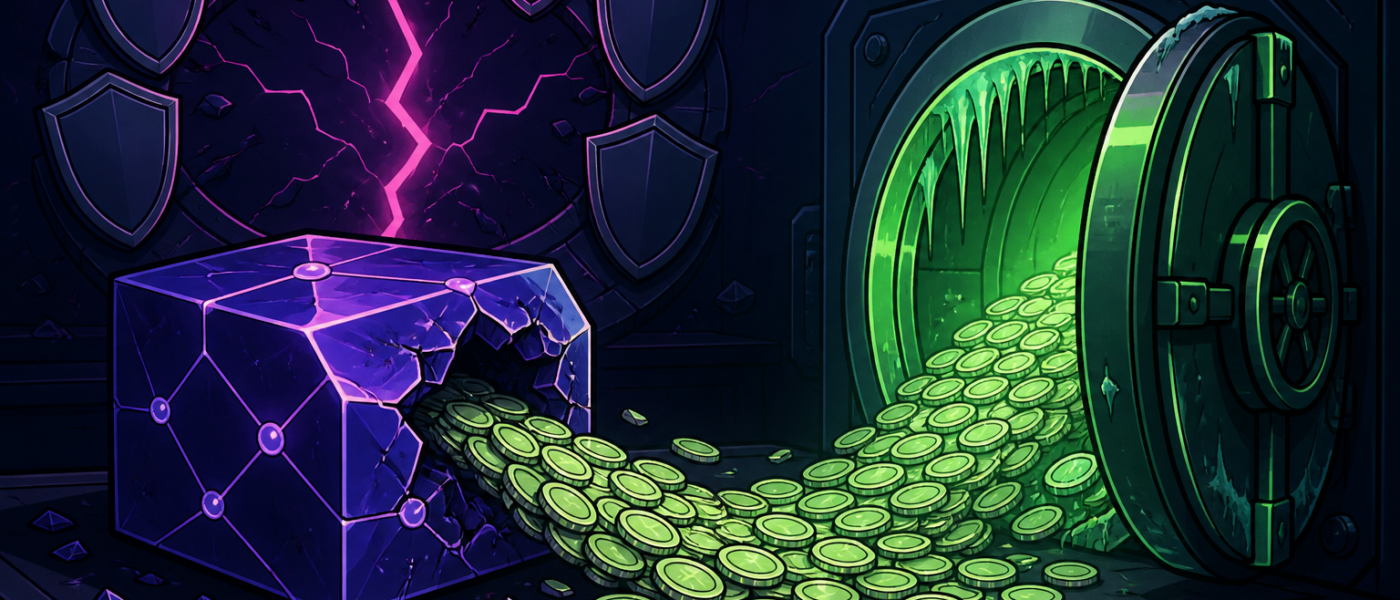
Harmony confirmed an unauthorized mint of roughly 4 billion ONE tokens on 12 August 2026, a print large enough to lift supply by more than a quarter. The same morning, the project’s official harmony-one/harmony repo merged a quorum verifier fix that explains how an empty signer bitmap could still clear consensus checks. Exchange freezes matter for stolen inventory. They do not rewrite a broken committee check.
ONE last traded near $0.000802 (CoinGecko, fetched 2026-08-12T06:39:03Z), down about 34.8% over 24 hours after printing a fresh all-time low earlier in the session. Broader tape stayed quiet: Bitcoin at $63,623 (-0.3% 24h) and Ethereum at $1,886.44 (+0.8% 24h) on the up&down market snapshot fetched 2026-08-12T06:26:16+00:00.
What happened
On-chain monitors first flagged empty-block minting that created about 4 billion ONE. Roughly 2.8 billion of that inventory moved toward exchanges before venues could react, according to the same reporting trail outlets used Wednesday morning. Harmony’s official account then said it was working with exchanges to stop and freeze funds, and that it was preparing a patch plus rollback options.
A follow-up Harmony post asked venues to block four addresses tied to the flow, publishing both ONE bech32 and 0x forms for two of them. That is a classic incident playbook: contain the float that can still hit books, then argue about chain surgery later.
Separately, and more important for how the mint was possible, Harmony maintainers merged pull request 5101 into main at 06:22 UTC on 12 August 2026. The commit message is blunt. uniformVerifier.IsQuorumAchievedByMask compared the full committee size against the threshold instead of counting bits actually set in the signer bitmap. An all-zero bitmap paired with an all-zero (identity) aggregate BLS signature could therefore satisfy quorum for a pre-staking-epoch committee. The patch counts enabled bits and rejects a nil mask. That is not marketing language. It is a forged-quorum path written down in public code.
Context
Harmony already carries a hard security memory. The 2022 Horizon bridge theft took close to $100 million and still sits in every risk memo about the chain. A 2023 token-creation bug improperly minted on the order of 146 million ONE. Wednesday’s print is larger by an order of magnitude and hits the base asset directly, not a wrapped bridge liability.
CoinGecko still showed circulating supply near 14.87 billion ONE around the dump, so a 4 billion mint is not a rounding error. It is a balance-sheet event for every holder, validator, and market maker still quoting the book. Liquidity on thin alt venues cannot absorb that float cleanly. Our market depth primer is the right lens: exit capacity collapses when the new supply arrives faster than bids.
Macro was not the spark. Bitcoin held a tight range while ONE cratered. This was idiosyncratic consensus risk, closer in spirit to the custody and signing failures we covered on BTCPay’s LND patch after live theft than to an ETF-flow day. If you want a longer arc on how layer-1 trust gets priced, the Ethereum history page still shows why shipped client fixes beat roadmap slides.
Our read
I am not treating the exchange freeze list as the main story. Freezes are inventory control. The falsifiable center is the quorum bug Harmony just patched in public.
Stance: until a clear majority of mainnet validators are running a build that includes the enabled-bitmap quorum check (PR 5101 or a successor release that carries the same logic), ONE should be priced as a consensus forgery risk, not as a temporary dump that venues can paper over.
Falsifiable claim: by 2026-08-19 23:59 UTC, Harmony publishes a technical note (GitHub security advisory, tagged release notes, or signed protocol post) that attributes the unauthorized mint to the empty-bitmap / identity-BLS quorum acceptance path described in PR 5101, and posts a validator upgrade advisory naming the fixed binary. If the only public explanation stays a vague “exploit” with no consensus-path detail, or if validators are left on pre-fix builds without a forced upgrade call, this read is wrong.
Rollback talk is the secondary fork in the road. A rollback can claw back minted balances that never sold. It cannot, by itself, prove the verifier math is fixed on the nodes that will produce the next thousand blocks. Show me the fee and the binary, not the apology thread.
For traders, that also means counterparty risk is not only the attacker wallet. It is every CEX still listing ONE while deposit/withdrawal status is unclear, and every bridge or wrapped ONE market that prices parity as if supply were closed. Wallet hygiene still matters when incident dust shows up in unexpected places; start with our wallet safety guide if you are moving residual balances.
What to watch next
- Validator binary status: Harmony release notes or Discord/X ops posts naming the fixed tag, plus explorer evidence that producing nodes upgraded.
- Exchange freezes: whether the four listed addresses stay blocked and whether any of the ~2.8B ONE that reached books gets clawed via venue holds rather than chain surgery.
- Supply prints: CoinGecko / explorer circulating supply over the next 48 hours. A sticky jump without a rollback keeps the dilution permanent for spot holders.
- Rollback decision: a concrete height/range proposal with social consensus, or an explicit decision to skip rollback and rely on freezes plus the patch.
More desk coverage of chain security and market structure lives under Blockchain News. The useful habit this week is simple: when an L1 says “we are freezing funds,” open the client diff before you open the chart.